The Residency
Students work on a real problem from an industry leader, in a real workplace, with a team of AI coworkers available whenever they need them to brainstorm, research, build, and move their work forward.
Every week, they meet with experienced mentors during office hours for feedback, guidance, and a fresh perspective on their work.
They present what they create at Demo Day to the person who set the problem, and publish their finished work in the Flintolabs Marketplace.
Just about an hour a week, alongside the school they already attend.
Watch
Inside the Flintolabs residency
Getting there
Four semesters, taken one at a time.
The residency happens in semesters 3 and 4. Students earn their way in through the first two semesters, where they learn the foundations and master the framework. Enroll one semester at a time and stay because it’s working.
Learn by Building
Building with AI from a blank page: prompting, APIs, data, and the tools professional teams use. Shipping from week one.
Their first working appBuild Your Idea
Their own idea, taken the whole way: discovery, validation with users, a working product, a pitch.
Unlock college creditBuild for a Real Challenge
A real problem from an industry leader, run with weekly mentor reviews and presented at Demo Day.
Real project with advisorExplore Another Domain
A second residency in a new field: research, analytics, product, or code.
Advanced advisor projectThey don’t take a class.
They join a team.
Your child works a live problem the way a product team does, with people who have shipped looking over the work every week.
A real problem from an industry leader
Not a textbook exercise. A working leader brings a problem they actually care about, and your child chooses from that library.
Weekly check-ins with your mentors
Live working sessions to shape their ideas, pressure-test their approach, and level up their craft. The high-impact dynamic of a startup accelerator.
Pitch decks and real customer feedback
Your child brings their idea to real users, gathers feedback, and evolves their product based on genuine insights.
Demo Day with the person who set the problem
The industry sponsor engages with what your child built, live. A conversation about the work, not a rehearsed presentation.

The workspace
Not a chat window. A place of work.
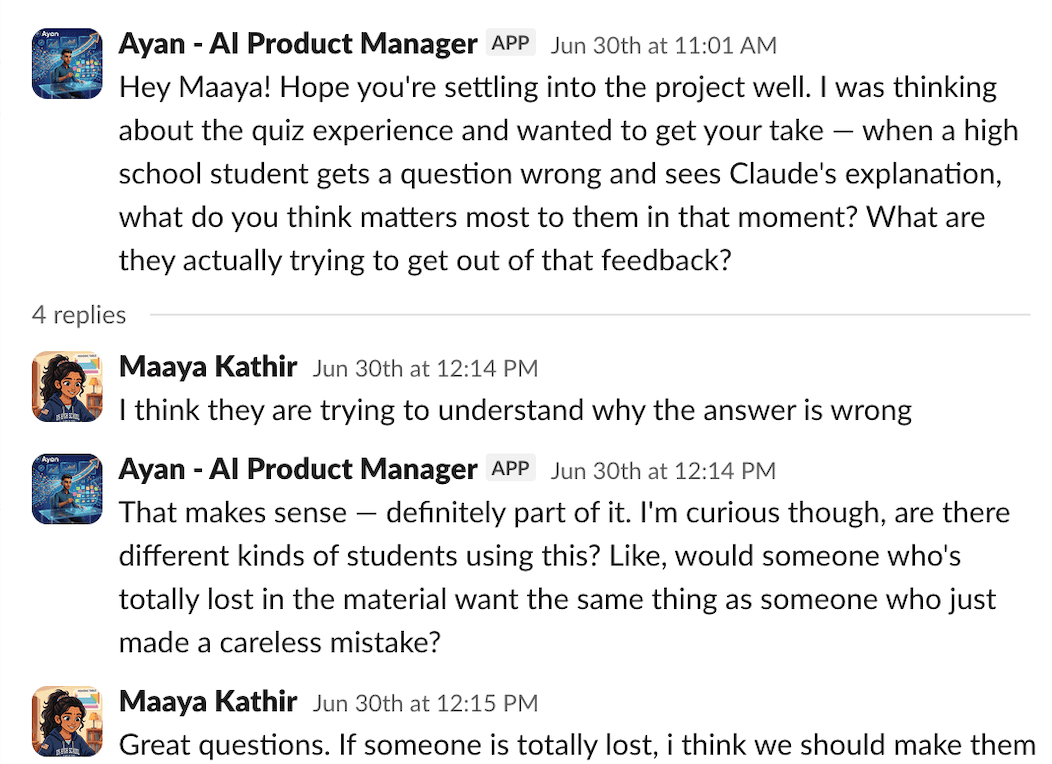
Your child does not sit alone with a chatbot. They work in a Flintolabs workspace alongside a team of AI coworkers, available whenever they need them: to brainstorm an idea, research what has already been tried, review the code, or push a pitch further than it would have gone alone.
Everything is recorded. Every decision, every revision, every thing they got wrong and then fixed. That record becomes feedback for the student on which durable skills they are strong in and which ones need work. This is the kind of feedback that helps them create their future, not just grades and a transcript.
This system is patent pending.
What they actually learn.
The tools change every year; these do not. Every semester of real work exercises the same craft.
AI fundamentals
Prompting, APIs, data, and the tools professional teams use, learned by building, not by lecture.
Weekly working labs
Live small-group sessions that shape the idea, pressure-test the approach, and level up the craft.
Startup methodology
Discovery, validation with real users, iteration, and a working product taken the whole way.
Pitching & internship-ready skills
Communicating the work to coworkers, sponsors, and a live Demo Day audience: the skills a first employer asks for.
Why this is future-proof
We don’t teach today’s AI tools. We build what outlasts them.
The tools your child uses this semester will be different in two years. That’s fine. The tools were never the point. Every semester of real work exercises the same set of capabilities, and that set doesn’t expire:
Solving unfamiliar problems: the kind no course prepared them for.
Learning continuously: picking up whatever the problem demands.
Exercising judgment: deciding what is good enough to ship.
Directing AI, not depending on it.
Communicating ideas: to coworkers, sponsors, and a live Demo Day audience.
Taking ownership: their name on the outcome, every time.
Creating value: turning knowledge into something people actually use.
Adapting as tools change: they already have, semester after semester.
AI tools will change. Careers will change. The ability to repeatedly learn, adapt, and create value compounds through all of it.
What your child walks out with.
A portfolio of products that work
Original apps they designed, built, and shipped for people to actually use. One every semester, not one at the end.
A documented body of work
Decisions, reviews, feedback, iterations. A visible record of how they built it, not just that they did.
Transferable college credit
College credits for a STEM course from CU Denver, earned through the work. We cover the university fees.
Self-direction and confidence
The two things parents tell us they want most. Not taught in a lesson, grown by owning something with their name on it.

Fits around the life they already have.
Nothing gets left behind. Their friends, their team, their sport, their classes. One live hour a week, on a weekend.
Homeschool families: the residency slots cleanly into a homeschool week, and the shipped product and college credit give a homeschooled student the external, verifiable record that transcripts often lack.
Years before anything is at stake.
They find what they love by actually building it, then walk into 9th grade as someone who already ships. Demo Day and college credit are open to them too.
Proof, right when the world asks.
The same work converts into a visible record: a shipped product, a Demo Day conversation with an industry leader, transferable college credit.
Questions
Questions parents ask.
See whether the residency is right for your child.
Book a call and we’ll walk you through what your child would work on, who they’d work with, and whether this is the right fit.