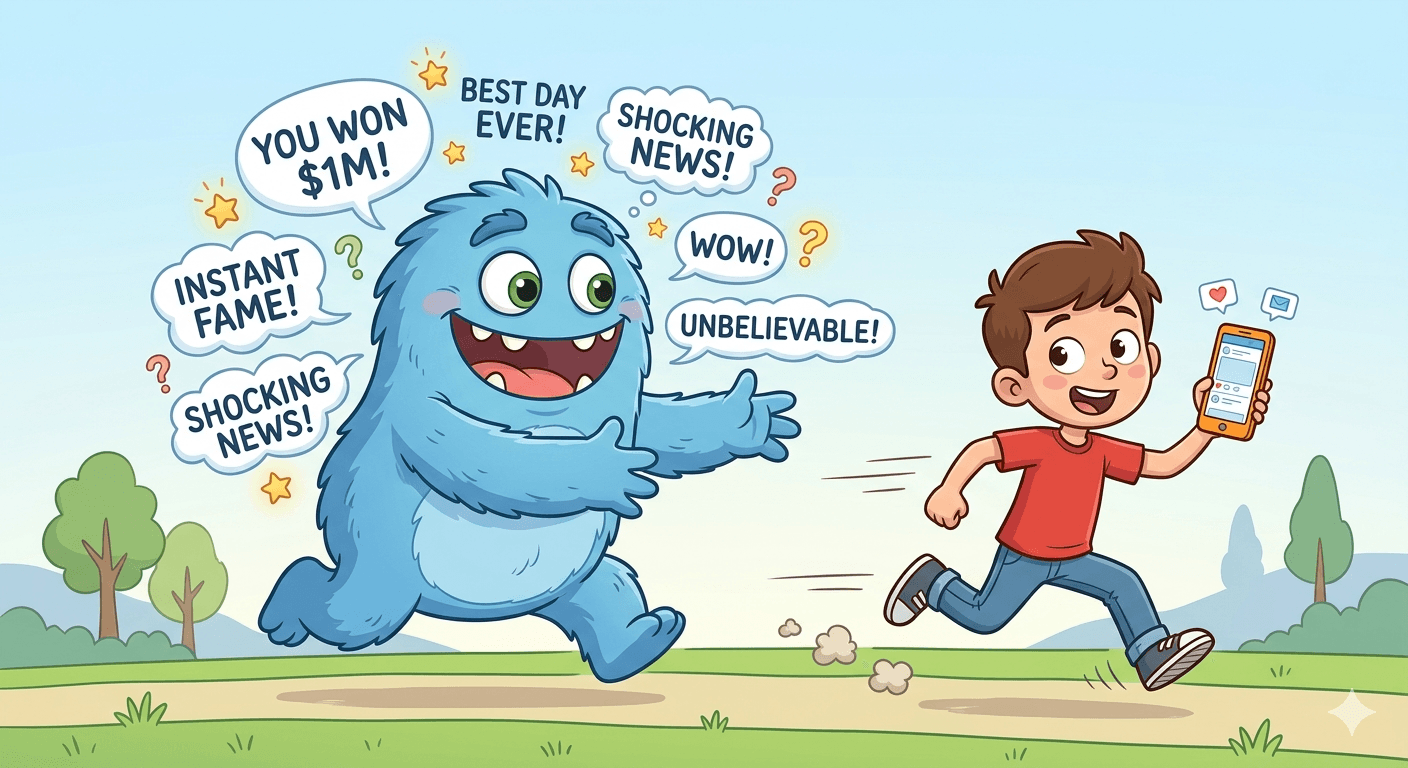
AI answers close questions. Building opens ten more.
A new TechTrends paper argues AI's talent for answering questions may be teaching a generation to stop asking them.

A new paper in TechTrends makes an argument that should stop every AI educator in their tracks. In "The Curiosity Paradox," researchers Punya Mishra and Danah Henriksen argue that generative AI, precisely because it is so good at answering us, may be quietly teaching a generation to stop asking questions.
It is a serious paper, and it deserves a serious response. Ours is narrow: they are right about most of it, and wrong about the part that matters most to us.
What the new paper gets right
Their case rests on a distinction worth taking seriously. Psychologists separate two kinds of curiosity. Discovery curiosity is the pull of wonder: you follow a tangent because it fascinates you, and each answer opens a new door. Deprivation curiosity is the itch of not-knowing: you want the gap closed, the answer delivered, the discomfort gone. One expands the mind. The other just wants the loop shut.
AI, the paper argues, is built to close loops. Trained to please, it hands you a fluent, confident answer and dissolves the tension that might have pushed you deeper. Ask a question, the itch goes away. Repeat that thousands of times and a student may learn to associate learning with relief rather than exploration. The authors call this the deprivation curiosity trap, and they warn that it operates most strongly not in classrooms but in the private, unsupervised spaces where students now spend most of their time with AI.
They are right to worry. If a student's entire relationship with AI is asking for answers and taking what comes back, the trap is real. The distinction is sound, the research is careful, and the concern is not one to wave away.
But "using AI" is not one thing
Here is where we part ways with the conclusion. The paper treats "using AI" as a single act. It isn't.
There are two very different things a student can do with an AI system. They can consume it, asking for the answer and accepting what comes back. Or they can build with it, using it to make something that has to actually work. These are not the same posture, and they do not feed the same kind of curiosity.
Consuming AI is exactly the behavior the paper describes: the answer is the destination, and once you have it, you stop. Building with AI works in reverse. The answer is never the destination. It is a tool, and the tool immediately reveals the next obstacle.
Building manufactures the friction AI removes
Watch a student build and the trap the paper describes simply does not appear.
At Flintolabs, students do not build generic assignments. They build projects rooted in something they already care about, a game they wish existed, a problem they have run into, a topic they cannot stop thinking about. That starting point matters, because it means the question driving the work is never "what is the answer." It is "can I make this work." And every answer the AI hands back creates a new problem to chase. Fix the layout, and the data stops loading. Fix the data, and the logic breaks on the edge case they had not thought of. Each resolution is a doorway, not a full stop. That is discovery curiosity with an engine attached.
Here is why. When you just ask AI for an answer, the answer feels like the end. You got it, so you stop. But when you build something, the answer is only the start, because your project still has to work. The button works or it doesn't. The game runs or it crashes. It does not matter how smart the AI sounded. If something is broken, it stays broken until you fix it. AI can tell you that you are right even when you are wrong. A project that does not work cannot. Building gives students something AI will not: a real thing that refuses to agree with them just because they sound sure.
The paper is asking for exactly this
Read the conclusion of "The Curiosity Paradox" closely and this is precisely what it calls for. Mishra and Henriksen urge educators to design for "productive friction," to honor ambiguity instead of eliminating it, and to resist the lure of easy answers.
We agree completely. What the paper does not say, and what we see every single week, is that building with AI is one of the most reliable ways to deliver all three. Friction is not something you have to protect a builder from. It is the entire experience. The false start, the bug that will not die, the version that works but is ugly and has to be torn down: that is where the learning lives, and a real project guarantees a student meets it. You cannot smooth those edges away, because the project will not run until they are solved.
Passive use removes the friction. Building manufactures it. Same technology, opposite outcome.
Which curiosity AI feeds is up to us
This is why, at Flintolabs, our thesis has never been "use AI." It is build with AI, not just use it. That single choice decides which kind of curiosity a student practices.
Generative AI does not have a fixed effect on the mind. It amplifies whatever a student brings to it. Hand it to someone chasing answers and it will close their questions, exactly as the paper fears. Hand it to someone building something and it becomes an engine for the discovery curiosity educators have wanted all along. We have written before about AI's limitations, and this is the practical upshot: the students who learn where AI falls short are almost always the ones who have watched it fail inside a project they were trying to ship.
The bottom line
The curiosity trap is not a property of the technology. It is a property of how we teach students to hold it. Teach them to consume, and the paper is right: AI will train them to prefer the comfort of an answer over the discomfort of a question. Teach them to build, and the same tool starts opening ten questions for every one it closes.
So the work is not keeping AI away from students, and it is not handing them answers faster. It is putting them in the position where AI opens questions instead of closing them. The technology can be a mirror or an engine. Which one it becomes is a matter of judgment, and judgment is the one thing AI cannot hand you.
References
Mishra, Punya, and Danah Henriksen. "The Curiosity Paradox: How Sycophantic GenAI May Undermine Learning." TechTrends, vol. 69, 2025, pp. 1127-1133, https://doi.org/10.1007/s11528-025-01156-z.
Harvard Business Publishing Corporate Learning. "Learning Through Experimentation: Why Hands-On Learning Is Key to Building an AI-Fluent Workforce." Harvard Business Impact, March 2025, harvardbusiness.org/insight/learning-through-experimentation-why-hands-on-learning-is-key-to-building-an-ai-fluent-workforce.
Comments (0)
No comments yet. Be the first to share your thoughts!